what is going on in st joseph missouri for the weekend of march 16 to 18, 2018
| Saint Joseph's Twenty-four hour period | |
|---|---|
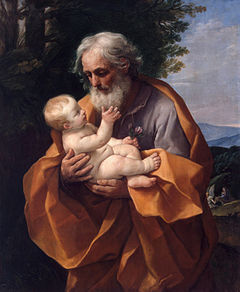 Saint Joseph with the Infant Jesus by Guido Reni, c 1635 | |
| Besides called | Feast of Saint Joseph |
| Observed past | Cosmic Church Lutheran Church Anglican churches |
| Celebrations | Carrying blessed fava beans, wearing red-coloured vesture, assembling abode altars dedicated to Saint Joseph, attention a Saint Joseph's Day parade |
| Observances | Church omnipresence at Mass or Divine Service |
| Date | March 19 |
| Frequency | every year (annual) |
Saint Joseph's Day, also chosen the Feast of Saint Joseph or the Solemnity of Saint Joseph, is in Western Christianity the primary feast day of Saint Joseph, married man of the Virgin Mary and legal father of Jesus Christ, celebrated on xix March. Information technology has the rank of a solemnity in the Catholic Church. Information technology is a banquet or commemoration in the provinces of the Anglican Communion,[1] and a feast or festival in the Lutheran Church building. Saint Joseph's Twenty-four hour period is the Patronal Feast day for Poland as well equally for Canada, persons named Joseph, Josephine, etc., for religious institutes, schools and parishes bearing his proper name, and for carpenters. It is also Father's Day in some Catholic countries, mainly Spain, Portugal, and Italy. It is not a holy day of obligation for Catholics in the United States.
19 March was defended to Saint Joseph in several Western calendars by the 10th century, and this custom was established in Rome by 1479. Pope Pius V extended its employ to the entire Roman Rite by his Apostolic Constitution Quo primum (14 July 1570). Originally a double of the second class and a feast of precept, information technology was re-raised to exist of precept in 1917 afterwards having this status intermittently lost, and consequently also raised to its current rank of double of the first class (now called a solemnity), having become in the concurrently the rank common to all remaining full general feasts of precept. Since 1969, Episcopal Conferences may, if they wish, transfer information technology to a date outside Lent. Even if it occurs inside Lent on the usual date of 19 March, it is still observed as a Solemnity of a Saint—this is one of the few times during Lent the Gloria may exist said or sung, the wear is inverse from the purple or violet of Lent to white or gilded (every bit it would be for such a solemnity normally), the Collect and the Eucharistic Prayer'due south Preface and other prayers are from the Solemnity and not Lent, the hymns are more blithesome, and the Creed is said. Withal, the Alleluia is still non used, the Tract being used instead, per Lenten regulations.[2]
Betwixt 1870 and 1955, an additional feast was celebrated in honor of Saint Joseph as Spouse of the Blest Virgin Mary and Patron of the Universal Church, the latter title having been given to him past Pope Pius 9. Originally historic on the third Sunday after Easter with an octave, subsequently Divino Afflatu [3] of Saint Pius 10 (see Reform of the Roman Breviary by Pope Pius X), information technology was moved to the preceding Wednesday (because Wednesday was the day of the week specifically dedicated to St. Joseph, St. John the Baptist and local patrons). The feast was also retitled The Solemnity of Saint Joseph. This commemoration and its accompanying octave were abolished during the modernisation and simplification of rubrics under Pope Pius XII in 1955.
At the same time, Pope Pius XII established an additional Feast of "St. Joseph the Worker", to exist celebrated on 1 May, in guild to coincide with the commemoration of International Workers' Day (May Mean solar day) in many countries. Until this time, 1 May had been the Feast of the Apostles Saint Philip and James, but that Feast was so moved to the next free twenty-four hour period, 11 May (and once more to 3 May, in 1969, having become free in the concurrently). In the new calendar published in 1969, the Banquet of Saint Joseph The Worker, which at one fourth dimension occupied the highest possible rank in the Church building calendar, was reduced to an optional Memorial, the lowest rank for a saint'due south mean solar day.[iv]
The Eastern Orthodox Church celebrates Saint Joseph on the Sunday after Christmas.[5]
Pop customs among Christians of various liturgical traditions observing Saint Joseph's Day are attending Mass or the Divine Service, wearing red-coloured wear, conveying dried fava beans that have been blest, and assembling dwelling altars defended to Saint Joseph.[half-dozen]
Christian traditions [edit]
March 19 always falls during Lent, a flavour traditionally marked past fast and forbearance. Saint Joseph'southward 24-hour interval, nonetheless, is a solemnity and per the 1983 Code of Canon Constabulary overrides Fri obligations in the Catholic Church building.[7] Previously, per the 1917 Code of Canon Law, the obligation of fasting and abstinence was non dispensed on St. Joseph's Day even where information technology was kept equally a Holy Day of Obligation: "On [Sundays] or feasts of precept, the law of forbearance or of abstinence and fast or of fast only ceases, except during Lent, nor is the acuity anticipated; likewise it ceases on Holy [Saturday] afternoon" (1917 Code, Canon 1252 § four).[viii]
If the feast twenty-four hours falls on a Sunday other than Palm Sunday, it is observed on the next available day, usually Mon, xx March, unless another solemnity (e.yard., a church building'due south patronal saint) falls on that day.[7] Since 2008, if Saint Joseph's Day falls during Holy Week, it is moved to the closest possible twenty-four hour period before 19 March, usually the Saturday before Holy Week. This change was announced by the Congregation for Divine Worship in Notitiae in order to avoid occurrences of the feasts of Saint Joseph and the Annunciation both being moved to just after the Easter octave.[9] This decision does not apply to those using the 1962 Missal co-ordinate to the provisions of Summorum Pontificum; when that missal is used, its particular rubrics, which require the feast to be transferred to the next available engagement subsequently xix March, must be observed. In practice, the 1962 rubrics lead to the observance of St. Joseph's Solar day on the Tuesday following the Second Sunday of Easter, as the Feast of the Annunciation (which must also be transferred in years when its assigned date, 25 March, falls during either Holy Week or the octave of Easter) is observed on the Mon afterward the Second Sunday of Easter.[ citation needed ]
Italy [edit]
In Sicily, where Saint Joseph is regarded by many as their patron saint, and in many Italian-American communities, thanks are given to Saint Joseph (San Giuseppe in Italian). Giving food to the needy is a Saint Joseph'southward 24-hour interval custom. In some communities it is traditional to wear ruddy clothing and swallow a Neapolitan pastry known as a zeppola (created in 1840 by Don Pasquale Pinatauro in Napoli) on Saint Joseph's Day.[ten] Maccu di San Giuseppe is a traditional Sicilian dish that consists of various ingredients and maccu that is prepared on this day.[xi] Maccu is a foodstuff and soup that dates to aboriginal times which is prepared with fava beans as a primary ingredient.[11]
I prominent custom is the Saint Joseph's day altar, which has spread from Sicily to the United states in the 1800s. These altars are typically elaborate; existence decorated with figurines, medals, and votive candles. The Saint Joseph's day altar is into 3 sections representing the three persons of the Trinity, and has a statue of Joseph at its head. The tables are dressed with nutrient, which are donated to the poor on the solemnity.[12] Upon a typical Saint Joseph's Day altar, people place flowers, limes, candles, vino, fava beans, specially prepared cakes, breads, and cookies (likewise every bit other meatless dishes), and zeppole. Foods are traditionally served containing bread crumbs to represent saw dust since Joseph was a carpenter. Because the feast occurs during Lent, traditionally no meat was allowed on the celebration table. The altar usually has three tiers, to represent the Trinity.[thirteen]
According to legend, Saint Joseph interceded to relieve a famine in Sicily during the Middle Ages. There was a severe drought at the fourth dimension, and the people prayed for their patron saint to bring them rain. They promised that if God answered their prayers through Joseph'due south intercession, they would set a large feast to honor him. The rain did come, and the people of Sicily prepared a large banquet for their patron saint. The fava bean was the ingather which saved the population from starvation and is a traditional part of Saint Joseph's Day altars and traditions.[14] On the Sicilian isle of Lipari, the Saint Joseph legend is modified somewhat, and says that sailors returning from the mainland encountered a vehement tempest that threatened to sink their gunkhole. They prayed to Saint Joseph for deliverance, and when they were saved, they swore to laurels the saint each year on his feast twenty-four hour period.[ citation needed ]
Some villages like Avola used to burn wood and logs in squares on the day before Saint Joseph, as thanksgiving to the Saint. In Belmonte Mezzagno this is currently still performed every year, while people ritually shout invocations to the Saint in local Sicilian linguistic communication. This is called "A Vampa di San Giuseppe" (the Saint Joseph's bonfire).
Spectacular celebrations are also held in Bagheria. Joseph is even celebrated twice a year, the 2nd fourth dimension being held specially for people from Bagheria who come up back for summertime holiday from other parts of Italy or abroad.
In Italia, 19 March is besides Father's Mean solar day.[fifteen]
Republic of malta [edit]
In Malta, the fix date for the celebration of Saint Joseph is 19 March, merely can exist moved if necessary to fit into the Lent and Easter season. This has been a day of remembrance in Republic of malta since the tenth century A.D. Almost businesses shut down for this day for all the celebrations that occur. The chief celebrations are held in Mdina, which is the "old capital" of Republic of malta in the suburbs of the city of Rabat.[xvi] There are three chief events that occur for this day. One of them beingness special masses in honor of Saint Joseph. Then information technology follows with colorful processions with music bands in the streets and fireworks at night. The chief procession takes identify in the evening with the statue of Saint Joseph being carried to the church of Saint Mary of Jesus. The statue represents a high level of workmanship for the effigy Joseph had in Jesus' life.[17] Also, this is one of the public holidays in Malta, known as Jum San Ġużepp. People celebrate mass in the morn, and in the afternoon get for a picnic. Information technology is a liturgical feast that occurs on a Dominicus in summer. Nevertheless, the city of Rabat celebrates the traditional Maltese feast where in the evening a procession is also held with the statue of Saint Joseph. On this solar day besides the metropolis of Żejtun celebrates the day, known as Jum il-Kunsill (Zejtun Quango's Twenty-four hours), till 2013 was known as Jum iż-Żejtun (Zejtun's Twenty-four hour period). During this 24-hour interval a prominent person from Żejtun is given the Żejtun Award (Ġieħ iż-Żejtun). In the past years the Żejtun Parish Church building has celebrated these feast days with a procession with the statue of Saint Joseph.[ citation needed ]
Spain [edit]
In Espana, Saint Joseph's Day is their version of Father's Solar day, which is called El Dia del Padre. In some parts of Espana it is celebrated as Falles. They experience that Saint Joseph is a skillful example of what a begetter effigy should be like, which is why they connect these two days. Since Spain does correlate this day with Father'southward Day, it is tradition for children to cook their fathers breakfast or even give small gifts. It is a "meatless affair", considering it occurs during the Lenten flavour. Some symbols to stand for this day include Jesus holding carpenter tools, baby Jesus, and a staff with lilies. A few things to do on this twenty-four hour period to celebrate are attention a special church building service, visiting different cathedrals, joining Valencia's Falla Festival, and exploring the city, museums and art galleries. The Falla Festival runs for 5 days and ends on 19 March in remembrance of Saint Joseph.[18]
Poland [edit]
In Poland, it is necessary to celebrate Imieniny or Namesday, the feast solar day of one'due south patron saint; celebrating Saint Joseph's Day is a part of this. Smooth families celebrate this twenty-four hour period with a Saint Joseph's tabular array in their house that is decorated with ruby-red and white for Poland and Saint Joseph. These tables fix in their house include holy cards and candles all around and meatless food in which they call a "festive fast" because it is Lent flavour. To correspond and honor Saint Joseph, Poland has hymns they made. A few of the hymns are Duszo moja, O Jozefie Ukochany, and Szczesliwy, Kto Sobie Patrona.[19]
Philippines [edit]
In the Philippines, especially in rice producing provinces like Iloilo, some families maintain the ritual of holding a feast for the Holy Family. An erstwhile human being, a young lady, and a pocket-size male child, often chosen from among the poor, are honoured as representations of Saint Joseph, the Blessed Virgin Mary, and the Child Jesus, respectively. The iii, sometimes dressed like the santo (traditional saint prototype) they each represent, are seated around a table set with the family's all-time silverware and people's republic of china, and served a variety of courses. Hymns are sung while they are literally spoonfed past senior members of the host family and important guests. The Novena to Saint Joseph is also recited at a nearby temporary altar. The hosts and other participants and so seek blessings from the "Holy Family" past paying obeisance to the iii individuals (or images of the holy personages they represent), either through kissing icons in the hands of the trio or performing mano, all while genuflecting before them. The now-fed "Holy Family" are lastly given donations (budgetary or in kind), which they separate amongst themselves, equally a thank-you gift after the anniversary.[20]
United States [edit]
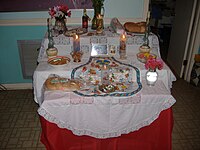
In New Orleans, Louisiana, which was a major port of entry for Sicilian immigrants during the late 19th century, the Banquet of Saint Joseph is a citywide event. Both public and private Saint Joseph's altars are traditionally built, especially in and around the Lake Vista neighborhood. The altars are usually open to any visitor who wishes to pay homage. The food is more often than not distributed to charity after the altar is dismantled.[21] Saint Joseph's altars can be institute in churches and public spaces throughout southeast Louisiana during this flavour.[ commendation needed ]
At that place are also parades in honor of Saint Joseph and the Italian population of New Orleans which are similar to the many marching clubs and truck parades of Mardi Gras and Saint Patrick's Day. Tradition in New Orleans too holds that past burying a small statue of Saint Joseph upside down in the front k of a house, that house will sell more promptly. In addition to the above traditions, some groups of Mardi Gras Indians stage their concluding procession of the flavour on the Sunday nearest to Saint Joseph's Day otherwise known every bit "Super Lord's day," afterwards which their costumes are dismantled.[22]
Saint Joseph's Day is too celebrated in other American communities with high proportions of Italians such as New York City; Utica/Rome, NY; Syracuse, NY; Niagara Falls, NY; Rochester, NY; Buffalo, NY; Hawthorne, NJ; Hoboken, NJ; Jersey City, NJ; Kansas Urban center, MO; Chicago, IL[23] Gloucester, Mass.; Hartford, Connecticut; and Providence, Rhode Isle, where observance (which takes place just after Saint Patrick'south Day) often is expressed through "the wearing of the red", i.e., wearing cherry clothing or accessories similar to the wearing of green on Saint Patrick'southward 24-hour interval. Saint Joseph'due south Day tables may too be found in Rockford and Elmwood Park, Illinois.[24]
Americans of Smooth ancestry, especially those in the Midwest and New England, who accept the proper noun Joseph celebrate Saint Joseph'southward Day (Dzien Swietego Jozefa) equally an imieniny. Equally a symbol of ethnic pride, and in solidarity with their Italian counterparts, Polish Cosmic parishes often hold Saint Joseph'due south Day feasts known as Saint Joseph's Tables or Saint Joseph's altars, and display statues and holy cards of Saint Joseph. As the day falls during Lent, these are meatless feasts.[25]
In the Mid-Atlantic regions, Saint Joseph's Day is traditionally associated with the return of anadromous fish, such as striped bass, to their natal rivers, such as the Delaware.[ citation needed ]
Saint Joseph's Day is also the solar day when the swallows are traditionally believed to return to Mission San Juan Capistrano after having flown s for the wintertime.[26]
Canada [edit]
Saint Joseph is the patron saint of Canada.[27] Saint Joseph'southward Oratory in Montreal hosts a novena and special masses to celebrate the feast of Saint Joseph. These events draw thousands of pilgrims to the basilica.[28]
England [edit]
Joseph of Nazareth is remembered in the Church building of England with a Festival on xix March.[29]
Run across also [edit]
- Calendar of saints
References [edit]
- ^ The Prayerbook Gild of Canada Archived iv Nov 2013 at the Wayback Auto
- ^ Calendarium Romanum (Libreria Editrice Vaticana 1969), p. 89
- ^ Latin original of Divino Afflatu; English language translation
- ^ Calendarium Romanum (Libreria Editrice Vaticana 1969), p. 92
- ^ "St. Joseph – Questions & Answers". www.oca.org. Orthodox Church building in America. Retrieved eight March 2021.
- ^ Jankowski, Nicole (18 March 2017). "Move Over, St. Patrick: St. Joseph's Feast Is When Italians Parade : The Salt : NPR". NPR. Retrieved 20 March 2017.
- ^ a b Miller, Jennifer Gregory. "The Oases of Lent: Celebrations of St. Patrick, St. Joseph, Proclamation and Family Days". www.catholicculture.org . Retrieved eight March 2021.
- ^ Monsignor Jason Gray of the Diocese of Peoria. "1917 Lawmaking of Catechism Law". www.jgray.org . Retrieved 16 March 2021.
- ^ "Notificazione". Notitiae. 475–476 (in Italian). Congregation for Divine Worship and the Field of study of the Sacrements. 42 (3–iv): 96. March–April 2006. Retrieved 15 February 2021.
- ^ "Non-Stop New York'south Italianissimo: La Festa di San Giuseppe NYC-Mode". AOL. Archived from the original on seven November 2006.
- ^ a b Clarkson, Janet (2013). Food History Almanac. Rowman & Littlefield. p. 262. ISBN978-1442227156.
- ^ "St. Joseph's Day Altars". www.neworleans.com. City of New Orleans. Retrieved 8 March 2021.
- ^ "Louisiana Project – St. Joseph's Day Altars". houstonculture.org.
- ^ Jankowski, Nicole (18 March 2017). "Move Over, St. Patrick: St. Joseph'due south Banquet Is When Italians Parade". NPR.org . Retrieved 8 March 2021.
- ^ "Father'south Day in Italian republic in 2021". Office Holidays . Retrieved 30 June 2020.
- ^ "nineteen March – St. Joseph Day in Malta". aum.edu. American University of Malta. 18 March 2020. Retrieved 9 March 2021.
- ^ "Banquet of St Joseph 2018 and 2019 — Public Holidays Malta". Public Holidays Republic of malta . Retrieved 8 May 2017.
- ^ "St Joseph's Day 2018 and 2019 — Public Holidays Spain". Public Holidays Kingdom of spain . Retrieved eight May 2017.
- ^ Gunkel, Ann/David. "Smooth Easter Traditions * St. Joseph's Day/Dzien Sw. Jozefa, March 19". annhetzelgunkel.com . Retrieved 4 May 2017.
- ^ "Feast of San Jose: Traditions, rituals and gastronomy". Flavours of Iloilo. nineteen March 2014. Retrieved 19 March 2019.
- ^ "St. Joseph'due south Solar day Altars". neworleansonline.com.
- ^ "Mardi Gras Indians Super Sunday around St. Joseph'due south Day". mardigrasneworleans.com.
- ^ St. Joseph'due south Twenty-four hours commemoration sets the table for sharing; Chicago Dominicus-Times
- ^ Pisano, Maryanne, "St. Joseph'south Twenty-four hour period feast table raises coin for charity", Sun Times, March xviii, 2013
- ^ Barbara Rolek. "St. Joseph'southward Twenty-four hours in Poland – How St. Joseph'south 24-hour interval Is Celebrated in Poland – Dzien Swietego Jozefa". Well-nigh.com Food.
- ^ "Signature Events – Mission San Juan Capistrano". missionsjc.com. Archived from the original on 11 March 2013.
- ^ Kokoski, Paul. "St. Joseph, Patron Saint of Canada and the Universal Church". Canada Gratuitous Press . Retrieved xviii March 2021.
- ^ "Saint Joseph's Oratory Welcomes Thousands of Visitors to Celebrate the Banquet of Saint Joseph". www.newswire.ca . Retrieved eighteen March 2021.
- ^ "The Calendar". The Church of England . Retrieved 27 March 2021.
External links [edit]
- Catholic Church Calendar
- Anglican Agenda
- Saint Joseph'southward Twenty-four hour period Altars
- Prayer to Saint Joseph
- Saint Joseph'south Twenty-four hours - Fathers Day
Source: https://en.wikipedia.org/wiki/Saint_Joseph%27s_Day
0 Response to "what is going on in st joseph missouri for the weekend of march 16 to 18, 2018"
Post a Comment