what happens to leftover food in food stores
Food Waste in America in 2022:
Statistics + Facts
With employees working from domicile, students learning remotely, and people ordering takeout to support their local restaurants, food bills skyrocketed1 as families spent more fourth dimension – and ate more than meals – at home. In the United states, the surge in food spending often translates to more food waste. Even prepandemic, we wasted massive quantities of food every single twenty-four hour period of the year.
Food takes up more infinite in US landfills than anything else.17
The Facts About Food Waste
How much food is wasted in America?
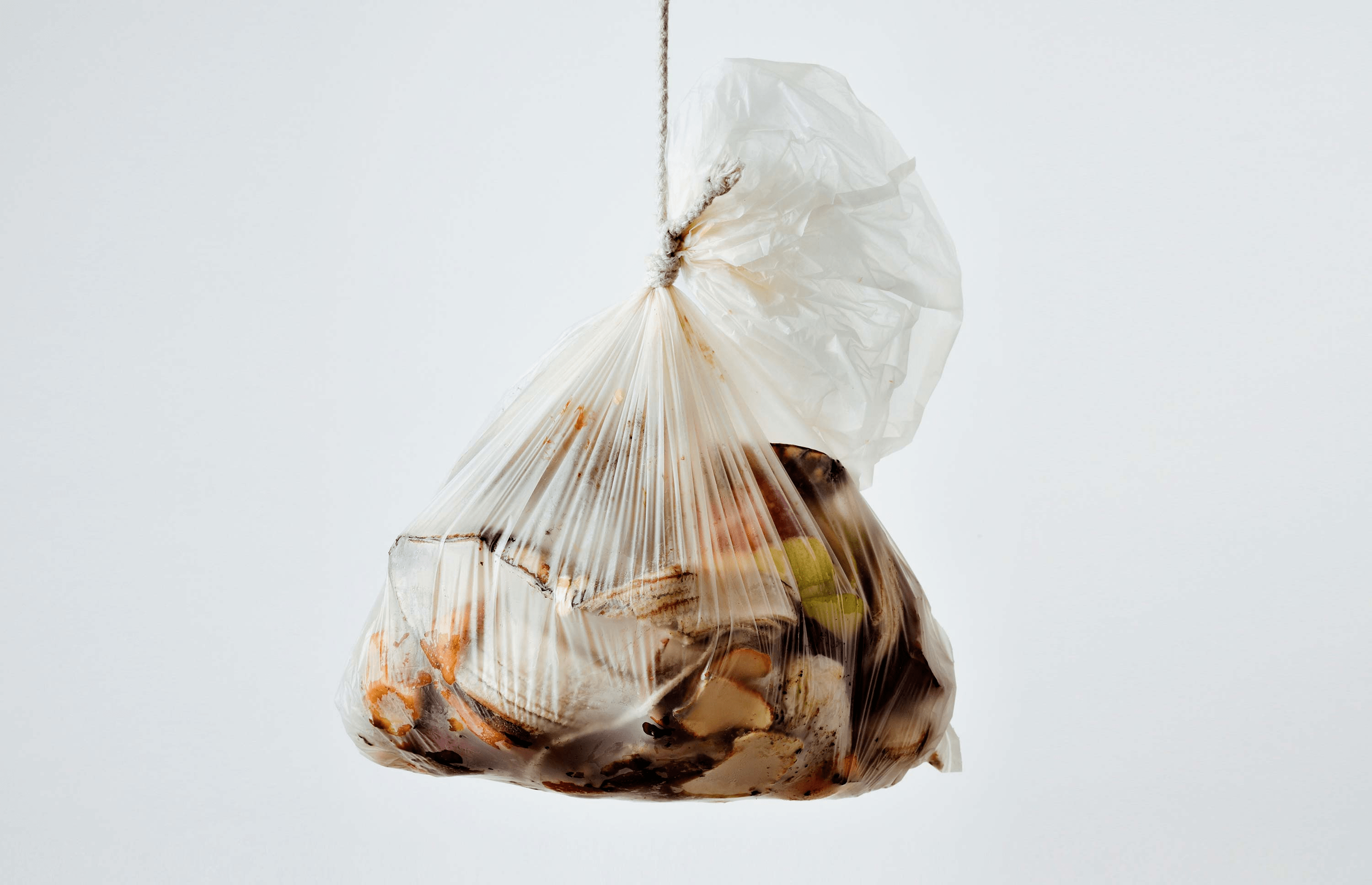
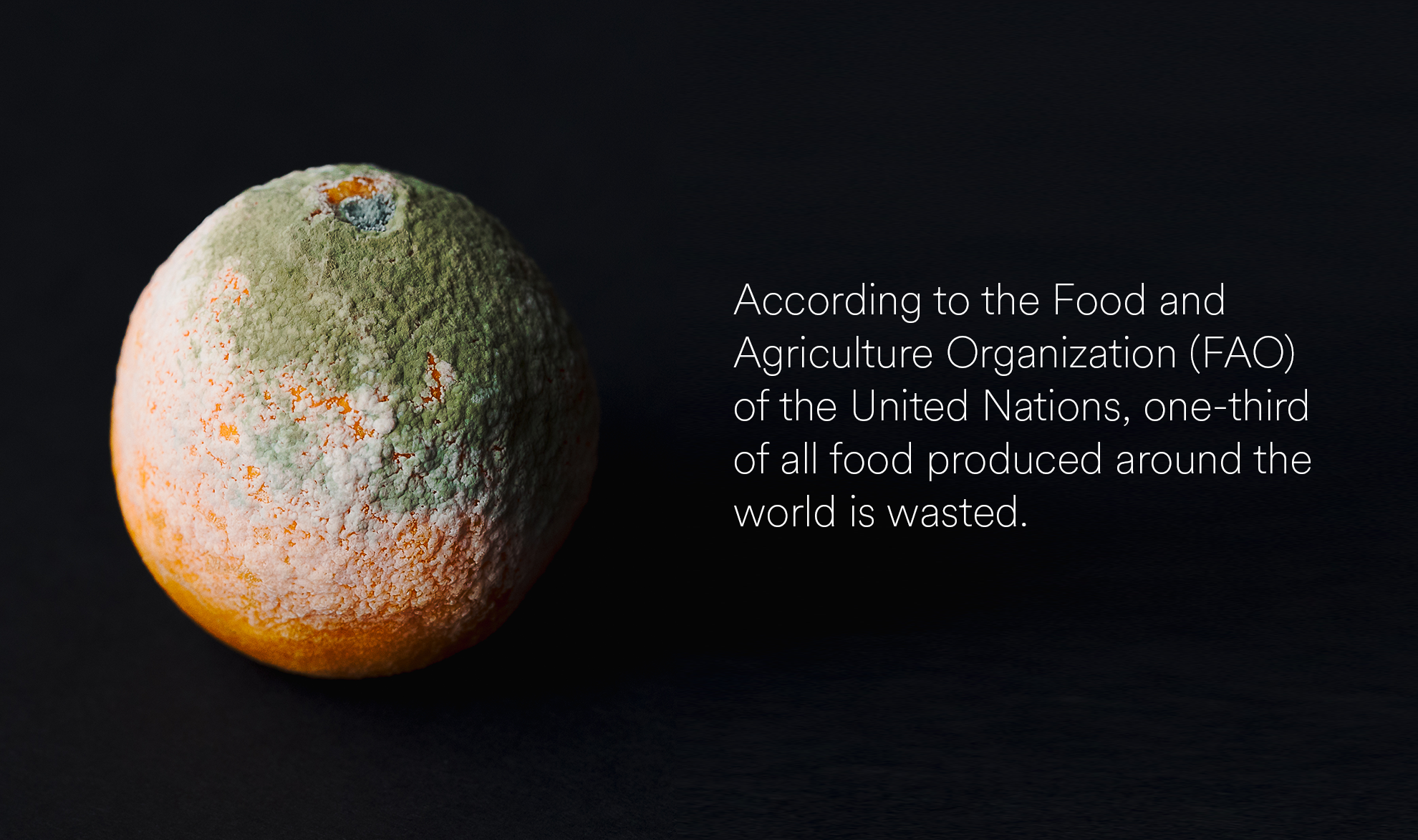
Just how much food do Americans waste matter? Here'due south some "food" for thought: While the earth wastes most ane.4 billion tons of food2 every year, the United States discards more than food than whatsoever other land in the world: well-nigh 40 million tons — 80 billion pounds — every twelvemonth.3 That's estimated to be 30-twoscore percent of the entire US food supply,4 and equates to 219 pounds of waste per person.five That's like every person in America throwing more than 650 averagesized apples correct into the garbage — or rather right into landfills, every bit near discarded food ends up there. In fact, food is the unmarried largest component taking up infinite within US landfills,6 making up 22 percent of municipal solid waste material (MSW).vii
Globally, we waste material about one.4 billion tons of nutrient every yr.15
Why do we waste material so much nutrient?
Before COVID-xix, it was estimated 35 million people across America — including 10 million children — suffered from food insecurity.8 That number is expected to increase to as much as fifty million people9 in 2022 due to the employment drib and financial fallout from the pandemic. With and then many people suffering who demand bones amounts of nutrient, why practise Americans waste so much of their nutrient abundance? Getting to the lesser of what causes food waste in America is a claiming that traverses the complex landscapes of socioeconomic disparities, confusion, and ingrained behavior, layered with human behaviors and habits. Food spoilage, whether real or perceived, is one of the biggest reasons people throw out food. More than 80 percent10 of Americans discard perfectly good, consumable food just because they misunderstand expiration labels. Labels similar "sell by", "use by", "expires on", "all-time earlier" or "best by" are confusing to people — and in an try to not take a chance the potential of a foodborne illness, they'll toss it in the garbage.
More than eighty per centum of Americans discard perfectly good food because they misunderstand expiration labels.xix
Compared to the residue of the earth, food in the United States is plentiful and less costly, and often this contributes to a general sentiment of not appreciating or valuing information technology the mode other communities around the earth do.
Americans are often impulsive in their food purchases, unrealistically assessing how much food is required, and equally a event buying more food than they demand or ownership food they won't actually eat.
Our accept-out guild doesn't use food in its entirety the way our ancestors used to. We underutilize leftovers and toss nutrient scraps that tin can still be consumed or composted.
Composting isn't part of our food-prep routine, so nosotros continue to add together fuel to the fire in increasing the sheer size of Usa landfills.
Americans discard more food than any other land, nigh forty 1000000 tons — or thirty-forty pct of the entire US nutrient supply.16
Changing the laws to curb so much waste
The practiced news is that several states across the country are taking action to curb food waste material and gain food recovery. Legislators in California, Connecticut, Massachusetts, New York, Rhode Island, and Vermont accept passed lawseleven that restrict the amount of nutrient waste material going to landfills. Vermont's "Universal Recycling Police force" went into effect in July 2020, banning food scrap waste entirely. According to the Vermont Foodbank, every bit a result of the new police force, food donations statewide have increased xl per centum.
There is pending legislation in California, Colorado and Massachusetts that would constitute programs to fund individual-sector composting and organic drove programs.8 In addition, several states like Tennessee and Washington, and cities similar Los Angeles and Madison, Wisconsin, have created nutrient waste product task forces to reduce waste material, creating composting didactics and infrastructure and eliminating food waste product from US landfills.
In 2019, the New York Urban center Department of Sanitation expanded upon their organics separation rules, proposing that fifty-fifty more than food-related businesses would be required to split up organic waste in an effort to keep about 100,000 tons of wasted food out of landfills each year.
The city and country efforts are trickling into U.s. school systems too — both Maine and Rhode Island have introduced legislation to reduce the amount of nutrient waste product in schools. On a national level, the US Department of Agriculture (USDA) and the US Ecology Protection Agency (EPA) set a goal in 2015 to reduce nutrient waste past half past 2030.
Before the pandemic, 35 1000000 people across America had nutrient insecurity. That number is expected to rise to every bit much as 50 million in 2022.18

Wasting food has environmental repercussions…
While the food waste move across America is gaining momentum, it needs to pick upwards speed to assistance tackle one of the globe'due south most pressing problems: climate alter. Wasting food has irreversible environmental consequences: it wastes the h2o and energy it took to produce information technology, and generates greenhouse gases — 11 percent of the world'southward emissions—12 like methane, carbon dioxide and chlorofluorocarbons, which contribute to global warming. Food that sits decomposable in landfills also produces nitrogen pollution, which causes algae blooms and dead zones. According to the Earth Wildlife Federation, the production of wasted food in the The states is equivalent to the greenhouse emissions of 37 million cars. If Americans continue on the same path of food loss, the ecology bear upon could be disastrous.
…and economical repercussions too
If reducing nutrient insecurity and saving the planet aren't enough to inspire action to reduce food waste material, perhaps one more adept reason volition: money. According to the nonprofit system Feeding America, Americans waste more than $218 billion each year on food, with dairy products beingness the nutrient item we toss out the most. The average American family unit of 4 throws out $i,600 a yr in produce. x Multiply that by the typical eighteen years that a kid lives at domicile and you could easily pay for a year'due south worth of tuition at whatsoever number of America's private colleges or universities.
Wasting food contributes to 11 pct of the world's greenhouse gas emissions.20
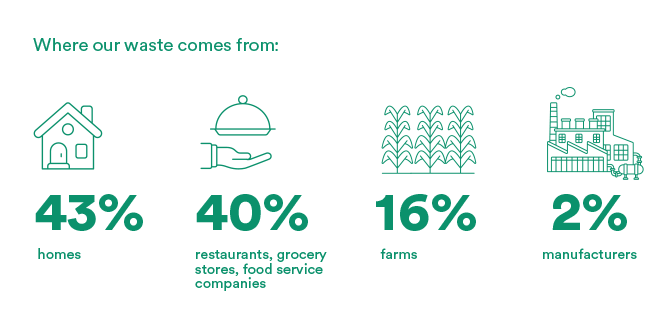
Solving the increasingly growing problem of nutrient waste product calls for upstream solutions that dig deep into the root of the problem. The root is complex and multifaceted, with waste coming kickoff from America's homes (43 percent) and restaurants, grocery stores and food service companies (40 percent), where people throw out food, followed by farms (xvi percent) and manufacturers (two percent), where too much food is produced.13
Against Waste and Solving the Trouble at Home
Then how exercise we tackle food waste in America? The challenge isn't to produce less food, simply to waste less in the process. Hither'due south how we tin can showtime:
Don't misinterpret expiration labels on nutrient that's perfectly expert to eat.
The Grocery Manufacturers Association, the Food Marketing Institute, and Harvard University take combined efforts to streamline expiration labels about the quality and condom of food. Two phrases simplify how you tin can tell what's nevertheless good to eat: 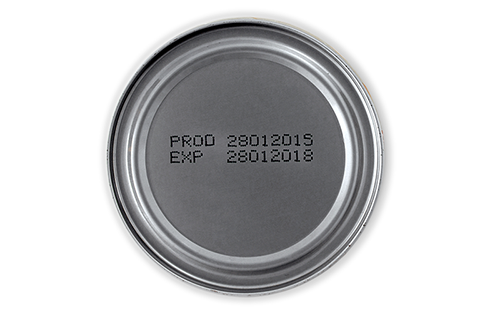 Best IF USED BY describes quality "where the product may not sense of taste or perform as expected but is safe to consume";
USE BY applies to "the few products that are highly perishable and/or take food safety concern over time."14
Larn how to compost to keep food scraps out of landfills, and the corporeality of greenhouse gases from rising.
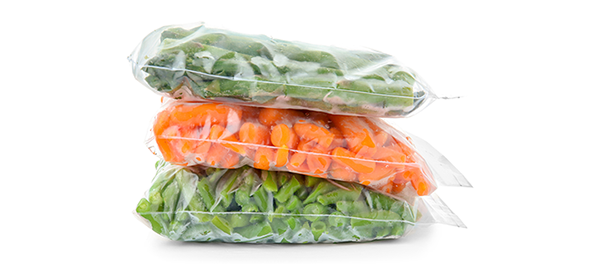 Freeze nutrient that tin can't be eaten immediately, only could exist consumed at a later date.
Share the wealth.
Donate food to food pantries or deliver leftovers to people who may demand it. Plan meals and brand deliberate grocery shop shopping lists. Fruits and veggies with blemishes and flaws notwithstanding taste the aforementioned and are typically a fraction of the cost. In addition to saving food, yous'll save money in the long run. Comprehend imperfect produce.
Plan meals and brand deliberate grocery store shopping lists.
Fruits and veggies with blemishes and flaws nevertheless gustatory modality the same and are typically a fraction of the cost. In improver to saving nutrient, you lot'll save money in the long run. Embrace imperfect produce.
Reducing the Waste at America's Restaurants
According to the Bureau of Labor Statistics, the average American household spends more than $three,000 a twelvemonth on eating out. This not only requires an astonishing amount of plastic packaging and utensils, simply it as well produces a lot of wasted food. The restaurant industry spends an estimated $162 billion every twelvemonth in costs related to wasted food.12 Pioneers in the recycling industry are making great strides, but there is still more we can do to brand progress.

Be thoughtful and deliberate when eating out.
Recognize that portion sizes differ and order only what y'all know volition be eaten. If y'all end upwards with leftover food – and this happens often with today's enormous American nutrient portions – take information technology home to share with someone else or to enjoy for some other repast the adjacent day.
If yous really want to be environmentally conscientious, bring your ain containers to accept habitation leftover nutrient. You'll be doing your role in reducing the 150 million tons of single-use plastic that we employ – and discard – every year. xiii
Reconsider the "all-you-can-eat" cafe-style restaurant model — and mindset.
It prompts people to take out more food than they can perhaps consume, and that food virtually always gets mindlessly thrown out afterwards piling a plate full.
Follow a global model.
Some countries effectually the world are alee of America when it comes to managing food waste. France, for example, requires restaurants to donate food that is at chance of being thrown out, but is still condom to eat. Cities in Sweden utilise food waste material to create fuel to power public bus transit. In Denmark, yous can use an app to find restaurants and bakeries that are near to shut and purchase their remaining food at a fraction of the toll.
Reducing Food Waste in Commercial Businesses
When it comes to food waste, households and restaurants aren't the merely contributors; commercial businesses as well add together to the growing problem.
Fortunately, there are many businesses that are taking notice. Companies are innovating new ways to use nutrient waste product equally ingredients for other products, setting upwards nutrient donation plans, or implementing commercial composting programs.
The Real Dill, a Denver-based pickle company, created a Bloody Mary mix out of the cucumber water used in making their pop pickles. Today, the mix is more than well-known than the pickles – and the company has an even smaller ecology footprint. Similarly, Wtrmln Wtr is a company that takes watermelons that would unremarkably be thrown out – and eventually stop upwardly in landfill – and creates a juice out of the melons. Companies aren't just creating food and potable products – some are taking businesses' food waste material and turning it into new products, like Ambrosia who is turning organic waste into a cleaning spray called Veles.
Companies are innovating new ways to utilise food waste material as ingredients for other products, setting upwards food donation plans, or implementing commercial composting programs.
Transforming food that would otherwise be wasted into an upcycled product is just one mode in which commercial businesses can reduce food waste. There are opportunities for commercial businesses to donate unused food like Sodexo has – altruistic all uneaten food to local communities in demand. These are all programs that support the United states Environmental Protection Agency'due south (EPA) Nutrient Recovery Challenge (FRC), which asks organizations and businesses to "pledge to improve their sustainable food management practices and study their results." Finally, companies tin also work with their hauler partner to set up programs to brand sure their organics are composted rather than sent to landfill.
Similar to how we tin can forestall nutrient waste at home, it's about making sure too much nutrient isn't purchased, redirection (or donation) of unused food that would otherwise be wasted, and, setting upwardly composting programs for food scraps that would cease upward in landfill.
Food is wasted along the entire supply chain
Farming Food Waste
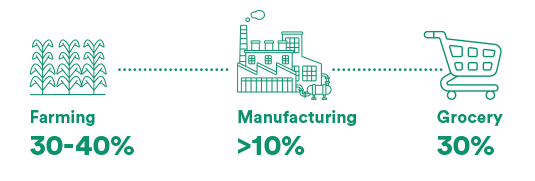
Approximately xxx-twoscore percent of food that farmers around the earth produce is never consumed. 21
Betwixt 21 and 33 pct of water used across US farms is wasted. 22
Food loss at the farm level depends on many uncontrollable variables, including the type and quality of crop, marketplace price and consumer demand.
If at that place's no market for a particular crop, it's better for the environs for farms to plow the crops dorsum into the world and have a loss before harvesting and packing up food to enter the supply chain. If the crop goes dorsum into the earth, it will aid produce improve soil for future harvests, just if the food isn't consumed, it will nearly oftentimes finish upwards in a landfill releasing greenhouse gases.
Manufacturing Food Waste
Human error, including lack of standard operating procedures and poor training, is the main crusade of food waste at the manufacturing level, accounting for more than than 10 percentage of food waste.
Food that is associated with a food allergy, such as peanuts or gluten, is oft wasted due to manufacturing lines that need to be run several times to produce an allergen-gratuitous product.
New product evolution creates food waste material due to the production processes that manufacturers must get through to coordinate correct volumes and product quality. Grocery Store Food Waste Virtually 30 percent of food in American grocery stores is thrown away.23 US retail stores generate about 16 billion pounds of nutrient waste every year. 24 Wasted nutrient from the retail sector is valued at most twice the amount of profit from food sales. 25
Grocery Store Food Waste
Near xxx percent of food in American grocery stores is thrown away. 23 United states retail stores generate almost xvi billion pounds of food waste every year. 24 Wasted food from the retail sector is valued at virtually twice the corporeality of profit from food sales. 25

What is the Food Waste Recovery Hierarchy?
There are many means to reduce food waste in the United States and around the globe — and thanks to the Food Recovery Hierarchy developed by the U.s. Environmental Protection Agency (EPA), we take a tiered organization that prioritizes prevention and then diversion of wasted food. Created as an inverted pyramid, the acme levels of the Bureaucracy are most favorable, trickling down to the last stage of waste sent to landfills. Here's how the Hierarchy flows:

i. Source Reduction
This goes dorsum to the simple lesson of "only accept what you lot need." If nosotros purchase and create less food, we'll throw less out. This is nearly simply reducing waste by non creating it in the first place.
two. Feed Hungry People
Much of the food we throw out is perfectly edible. With fifty million people expected to suffer from food insecurity in 2022 alone, this is unacceptable. Nutrient banks and shelters beyond the country would welcome the food that many Americans throw away.
iii. Feed Animals
Humans aren't the but ones who need to exist fed — our animals need sustenance as well. Those food scraps we toss later dinner each night — that will surely end up in a landfill — tin can exist saved for feeding farm animals, diverting more food waste from needlessly being thrown out.
4. Industrial Uses
Did you know that some of the nutrient you toss tin be used to create biofuel and bio-products that could power your automobile? The globe has provided alternative energy in the form of sunday and current of air. Why shouldn't our food be yet another way to source power?
5. Composting
Near the bottom of the Food Waste Recovery Hierarchy is something every single person is capable of doing: composting their food waste. Composting non only prevents your food waste from entering a landfill (and creating even more than greenhouse gases), but also improves soil and water quality that in turn, help future crops abound.
6. Landfill/Incineration
This is the bottom of the Food Waste Hierarchy — and the last, final resort to the waste that nosotros produce. Avoiding this tier starts with each and every 1 of us, by preventing waste product at the top of the tier — right where it's sourced and where nosotros can make different decisions well-nigh how much we take, buy and create.
It's about everyone doing their part, from individuals to large corporations — taking responsibility and making pocket-size changes to create meaningful sustainable changes for the planet.
DOWNLOAD NOW
Food Waste matter in America in 2022
Statistics + Facts
20 FACTS ON Nutrient Waste product
Food waste has a vast impact on our surroundings, lodge, and economic system.
Here are some fast facts to show the breadth of the impact:
Fact 1
Globally, if food waste could be represented as its own country, it would exist the third largest greenhouse gas emitter, behind Mainland china and the Us.
Acquire More.
Fact 2
I-third of all food produced in the world – approximately 1.3 billion tonnes – is lost or wasted every year.
Acquire More.
Fact 3
The resources needed to produce the food that becomes lost or wasted has a carbon footprint of about 3.3 billion tons of CO2. Not included is the GHG emissions from land utilize change.
Learn More than.
Fact 4
Produced merely uneaten food occupies almost one.iv billion hectares of state – roughly 30% of the world'southward agricultural land area.
Learn More.
Fact 5
Co-ordinate to FAO, the direct economic cost of food loss and food waste (aka food wastage) of agricultural products (excluding fish and seafood), based on producer prices only, is about 750 billion USD dollars.
Larn More.
Fact vi
To run across need of increasing world population, food production volition demand to be threescore percent higher than in 2005 past 2050 (Alexandratos & Bruinsma 2012).
Larn More.
Fact 7
In the The states, nutrient waste product is estimated at between 30-40 percentage of the food supply.
Learn More.
Fact 8
Most ii-thirds of food waste at home is due to food not existence used earlier it goes bad.
Acquire More than.
Fact ix
The EPA estimates that in 2018, 2.six million tons of nutrient was composted. That's only 4.i% of wasted nutrient.The EPA estimates that in 2018, 2.half dozen meg tons of food was composted. That's only iv.i% of wasted food.
Learn More than.
Fact x
The almanac value of food wasted globally is $i trillion.
Learn More than.
Fact 11
All the earth's nearly one billion hungry people could be fed on less than a quarter of the food that is wasted in the US, UK and Europe.
Acquire More than.
Fact 12
Reducing nutrient waste is the #one solution to the climate crunch, according to Project DrawDown – coming above electric cars, solar power and plant-based diets.
Learn More.
Fact xiii
The water used to produce the food wasted could be used by nine billion people at effectually 200 litres per person per twenty-four hour period.
Learn More.
Fact xiv
By 2050, the world population will hit ix billion people. By so, food production must be increased past 70% from today's levels to meet this demand.
Learn More.
Fact 15
In the US, organic waste is the largest source of methane emissions.
Learn More than.
Fact xvi
25% of the world's fresh water supply is used to grow food that is never eaten.
Learn More.
Fact 17
Considering of quality standards that rely too much on appearance, crops are sometimes left unharvested and rot.
Learn More than.
Fact xviii
Eliminating global food waste would save iv.4 1000000 tonnes of C02 a year, the equivalent of taking one in four cars off the road.
Learn More than.
Fact 19
Throwing away 1 burger wastes the same corporeality of water as a ninety-infinitesimal shower.
Learn More.
Fact 20
Agronomical production is responsible for at 33%, the greatest amount of total food wastage volumes. Upstream wastage volumes, including product, post-harvest handling and storage, represent 54% of total wastage,
while downstream wastage volumes, including processing, distribution and consumption, is 46%. Thus, on boilerplate, nutrient wastage is balanced between the upstream and downstream of the supply chain.
Larn More.
- 1 Chain Shop Historic period
- 2 United Nations' Nutrient and Agronomics Organisation (FAO)
- 3 Environmental Protection Agency
- iv U.South. Department of Agriculture
- 5-7 EPA
- 8-x Feeding America
- 11 National Council of State Legislatures
- 12 World Wild animals Fund
- 13 Feeding America
- 14 Natural Resources Defense Council
- fifteen Food and agriculture Arrangement (FAO) of the United Nations (Un)
- 16 Ecology Protection Agency
- 17 Environmental Protection Agency 1
- 18-19 Feeding America
- 20 World Wildlife Fund
- 21 Postharvest Education Foundation
- 22 Natural Resource Defense force Council
- 23 U.S. Department of Agriculture
- 24-25 ReFED 26 Dept of Agriculture
Source: https://www.rts.com/resources/guides/food-waste-america/
0 Response to "what happens to leftover food in food stores"
Post a Comment