Who Are the People That Watch the Babies in the Room When There First Born
/https://tf-cmsv2-smithsonianmag-media.s3.amazonaws.com/filer/bd/74/bd747f5d-7ff9-4a8b-b35a-3185fe7b4d03/man-at-viewing-window-pointing-to-baby.jpeg)
Sixteen minutes into the second episode of Hulu'due south newHandmaid'due south Tale, Offred (Elizabeth Moss), having recently given nascency to her starting time kid, follows a nurse to the hospital'south newborn nursery, where her baby will accept her showtime bath. Arriving at the nursery, Offred is taken aback by an unusual sight.
"Where are the babies?" she asks.
"Oh, we had a difficult night. Ii went to the intensive care unit, and the others all take died."
The camera zooms in on Offred every bit she looks in through a massive window into a newborn nursery with three rows of empty bassinets. Ominous music plays in the background. The scene serves as a bad omen of things to come for a community grappling with widespread infertility. AsHandmaid's' artistic team understands, an empty nursery is jarring. That viewers of all ages and life experience can easily recognize the gravity of a nursery devoid of babies speaks to the peculiar and particular office that plant nursery windows take played in modern American hospitals.
Newborn nurseries became fixtures of American hospitals in the early twentieth century, during the transition from domicile to hospital as the preferred and default place to give birth. When hospitals built new maternity units to house women during labor, delivery, and recovery, they besides built carve up nurseries where newborns were cared for, en masse, apart from their mothers.
These nurseries all shared a hitting similarity: they prominently featured large windows facing out to hospital corridors. These windows placed the hospitals' youngest patients on display for family unit, friends, hospital staff, and members of the general community. The 1943 edition ofStandards and Recommendations for Hospital Care of Newborn Infants, first published equally a collaboration between the American Academy of Pediatrics and The Children'southward Bureau, prescribed that "A viewing window should be provided between each plant nursery and the nurses' station, and ane betwixt each nursery and the corridor so that relatives may see the infants without coming in contact with them."
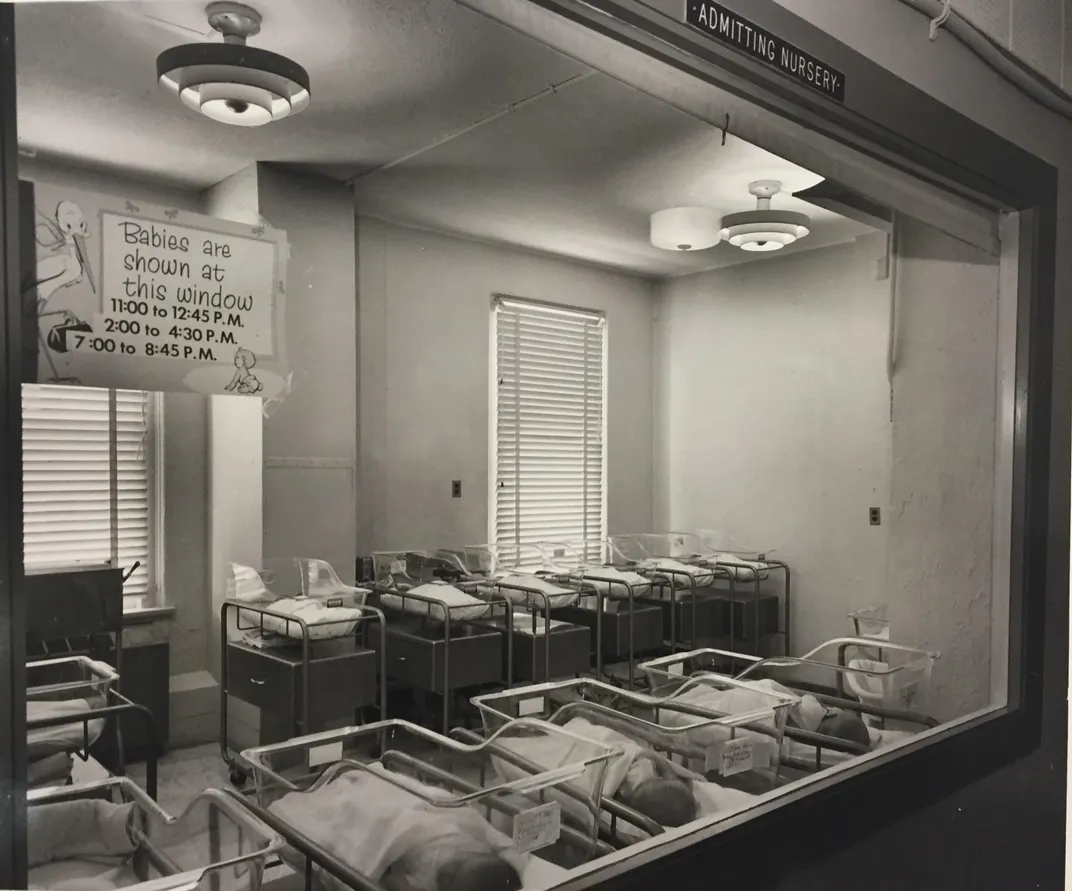
The stated purpose for the viewing window was twofold: showtime, the window allows relatives to "see the infants," and second, the window serves as a bulwark to forbid contact between relatives and the newborns they have come to see. Merely while hospitals justified the construction of these windows every bit sanitary barriers between newborns and the general hospital community, it's unlikely that infection prevention was a primary motivator. If windows served mainly equally antibacterial barriers, the hospitals would have had no reason to install them in the first place; standard windowless walls surrounding nurseries would accept been less trouble to build, and would have eliminated the potential for compromising the barrier between the nursery and the corridor via cracks betwixt the window and the wall. Thus, the ubiquitous nursery window served a primarily social function.
Roots for the do of clinical baby viewing may prevarication in the belatedly-nineteenth- and early-twentieth-century European and American tradition of incubator shows, which placed premature and otherwise weak infants on display in both permanent and traveling exhibitions. In the United States, incubator shows charged access and displayed sick infants among "ethnic villages and freak shows," most famously on New York's Coney Isle.
Of class, unlike incubator shows, newborn nurseries were spaces for the provision of clinical care—not for amusement—and were widely accepted and endorsed by mainstream medical organizations. Almost importantly, the babies displayed in the windows of newborn nurseries were well-nigh ever healthy. These windows were, at their cadre, displays of happy, healthy, and hopeful normalcy.
While big picture windows often displayed the swaddled newborns to all who passed through hospitals' corridors, some nurseries had specific times in the 24-hour interval reserved for family members and friends to get a closer look at a particular baby. During these more than intimate viewings, a nurse would oft concur a newborn upward to the window so that the eager observer could get a closer look. Admirers in this scenario could be mothers, grandparents, members of the extended family unit, or adoptive parents, just appear to take virtually frequently been fathers. For most of the twentieth century, fathers did not meet their babies in person until they took them home, and hospitals seem to take had fathers' desires in mind when designing nursery windows. A 1950 article inThe American Journal of Nursing reported on an innovative recessed nursery window installed in a hospital in California, which they called a "Baby Showcase." This window, they wrote, "is paying dividends in public relations value and making new fathers very much happier…"
The image of a father meeting his newborn through a pane of drinking glass too appears in endless family photographs from the mid-twentieth century, and was immortalized in all forms, from fine art to advertising. A full-page advert for The Prudential Insurance Company of America in a 1943 issue ofLIFE magazine uses the classic nursery window interaction between father, nurse, and babe to convince new fathers to purchase life insurance. The page features a large photograph of a handsome fellow, dressed in a adjust and necktie, smiling into the optics of his newborn child through a glass window. The babe is in the arms of a nurse, who cradles the babe, tilting the child towards its begetter. The photograph's caption reads, "PICTURE OF A Human being LOOKING INTO THE FUTURE," and below the tagline: "Row upon row of tiny bassinets – and a nurse holding upward a new infant.The babe! But Dad sees much more than a newborn son. He sees a long future stretching ahead…"
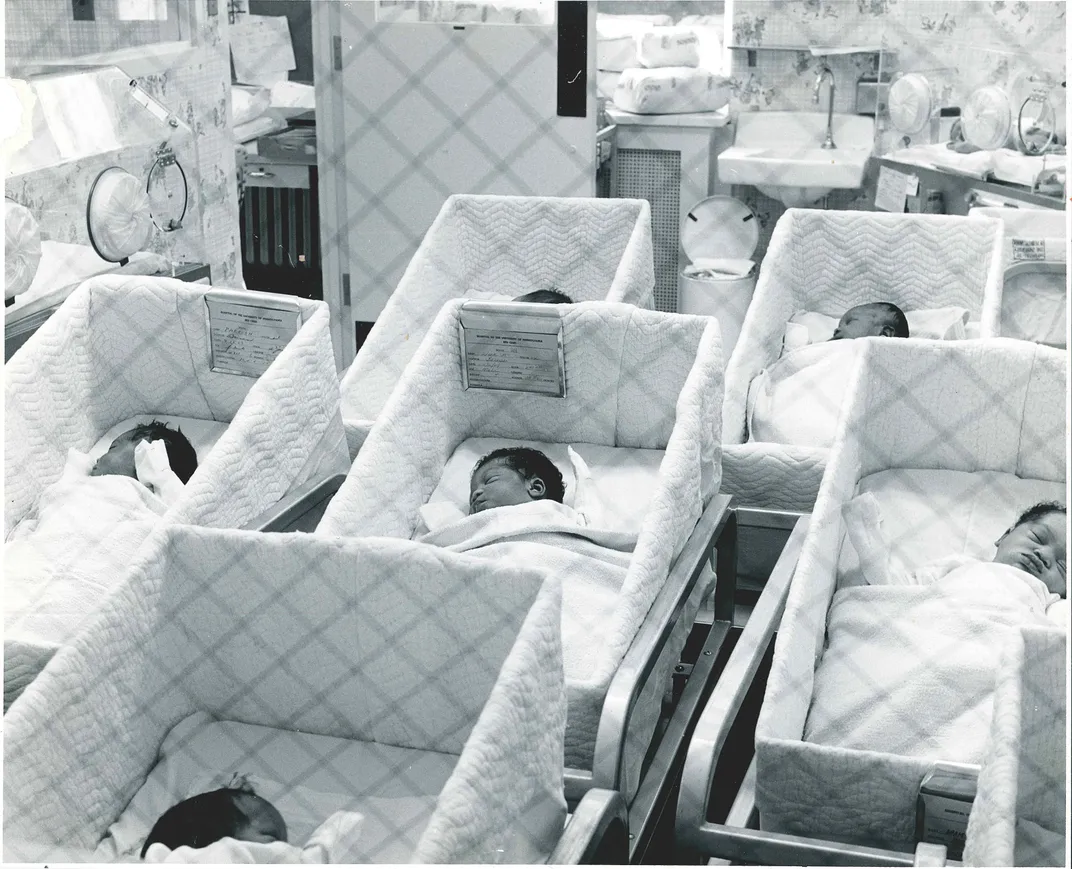
Today, newborn nurseries are no longer considered best practice in American hospitals, and their use is disappearing thanks in part to the widespread adoption of the WHO'due south 1991 Baby-Friendly Hospital Initiative (BFHI). The BFHI, a global plan to promote hospital practices that encourage breastfeeding, includes keeping salubrious mother-baby pairs together. As nurseries have begun closing, pop press coverage and professional discussions have reinforced the idea of the nursery window as a positive infinite in hospitals, both for babies' families and unrelated members of the community.
In 2002,The American Journal of Maternal and Child Nursing printed a fence on the topic of closing the nursery windows. Dotti James, PhD, RN, argued for keeping the windows open, in part considering for "family unit members, friends, and others… Seeing one of these little miracles engenders smiles and becomes a bright spot in the day." James also noted that, "in some hospitals the nursery window has go a destination for patients and families from other parts of the hospital experiencing a wellness crisis," and that "Standing outside the nursery, seeing the babies who have their lives before them tin can give hope to families trying to cope."
Also in 2002, aLos Angeles Times article echoed James' arguments, lamenting the closure of "the popular viewing areas, where infirmary visitors burdened by some of life's darkest moments could brighten their day a piddling simply by peering through the nursery window." In the aforementioned piece, Michael Baskt, executive director of Customs Memorial Hospital in Los Angeles, shared, "… For people where things are not going well, we recognize they would be attracted by the beauty of nascence.Sometimes people need to go from the sad, depressing side of the hospital to the happy side. Babies put things in perspective."
As influential thinkers and organizations continue to reimagine the postpartum flow equally a time for breastfeeding, clinically-managed bonding, and a jump start on developing the "correct" mothering habits, the iconic brandish of newborns continues. For better or for worse, whether in hospital-published "online nurseries," or as the backdrop for emotional scenes in television and movies, the tradition of the plant nursery window seems to be hither to stay.
This story was originally published on NursingClio , a collaborative weblog project that ties historical scholarship to present-day issues related to gender and medicine.
Source: https://www.smithsonianmag.com/history/why-hospitals-started-displaying-newborn-babies-through-windows-180964186/
0 Response to "Who Are the People That Watch the Babies in the Room When There First Born"
Post a Comment